

Hiring a human SDR to cover email and LinkedIn prospecting costs tens of thousands of dollars annually before you factor in tools, training, and ramp time. Gojiberry AI is pitching a different model: enter your website URL, let the platform learn your business, and watch an AI agent identify high-intent prospects and run multichannel outreach on your behalf.
The pitch is bold, the positioning is clear, and the $99/month entry point is hard to ignore. Whether the reality matches the marketing is a more layered question. This review works through the platform's core mechanics, its specific workflow tools, the pricing structure, and the credibility gap between "fully automated demo booking" and what independent evidence actually supports.
How Gojiberry AI Identifies High-Intent Leads
The foundation of the platform is its prospect identification engine, which the company describes as a "radar" for high-intent leads. Rather than requiring you to upload static contact lists or build filters from scratch, Gojiberry AI monitors buying signals and social signals across the web, then scores each discovered prospect against your ideal customer profile (ICP) to surface the contacts most likely to convert.
The onboarding mechanism that powers this is unusually lightweight. You provide your website URL, and the AI parses your value, target market, and positioning from that single input. This means the system can begin building a relevant prospect universe within minutes of setup, without requiring you to write persona briefs or configure complex targeting logic manually.
In practice, this signal-detection approach is designed to prioritize recency and intent. Rather than pulling a broad list of contacts who match a job title, the agent is supposed to surface people who are actively showing purchase-relevant behavior. The ICP scoring layer then ranks those contacts so your outreach budget, whether measured in email sends or LinkedIn connection requests, is directed toward the highest-probability targets first.
What the platform does not make explicit in available public documentation is exactly which data sources feed the signal detection, or how granular the intent signals are. Prospective buyers with niche markets or highly technical ICPs should verify directly with the team whether the signal layer covers their specific industry before committing.
Automated Multichannel Outreach Without Sequences
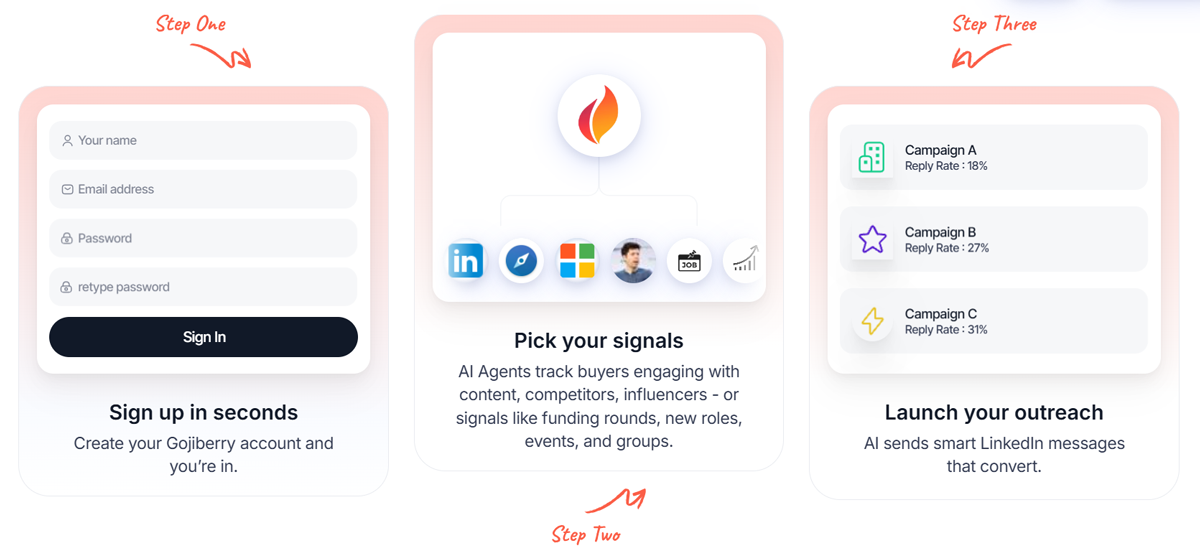
Once the prospect list is built, Gojiberry AI's outreach layer takes over. The core tool here is AI Personalized Messaging, which generates individualized outreach copy for both email and LinkedIn simultaneously. The key differentiator the company emphasizes is that there are no sequences to build. Instead of configuring a step-by-step cadence in a traditional sales engagement platform, the AI agent coordinates the timing and channel mix of touchpoints automatically.
This is a meaningful workflow departure from tools like Outreach or Salesloft, where a rep or ops team member typically designs each step, writes branching logic, and manages A/B tests manually. Gojiberry AI's agent is supposed to handle that coordination layer by itself, including Automated Campaign Optimization, which tracks what messaging converts and adjusts future outreach accordingly. The platform also benchmarks your campaign performance against top performers in your industry, giving you a relative sense of whether your results are above or below market norms.
For teams that have previously spent hours per week maintaining sequence hygiene, this hands-off model is the most clear part of the value. The trade-off is control. If you want to enforce a specific tone, require legal review of messaging before it goes out, or lock in a rigid follow-up schedule, the no-sequences architecture may feel opaque. The platform does allow users to review and approve AI-generated messages before the agent begins active outreach, which provides a checkpoint without requiring you to write every message yourself.
Managing the Pipeline: Unibox and Chrome Extension
Two specific tools handle the day-to-day management layer once outreach is running.
The Unibox is a centralized inbox where all lead interactions across email and LinkedIn surface in a single view. Rather than toggling between your email client, LinkedIn messages, and a CRM to track where each conversation stands, the Unibox consolidates that activity. For a solo founder or a small sales team running high-volume outreach, this kind of unified view reduces the cognitive load of pipeline management considerably.
The Chrome Extension addresses a different workflow need: lead sourcing beyond what the AI's automated signal detection finds on its own. If you use LinkedIn Sales Navigator or run standard LinkedIn searches, the extension lets you pull those contacts directly into the Gojiberry AI ecosystem without manual data entry or CSV exports.
This is useful when you have a specific account list you want to work, or when a sales navigator search turns up a cluster of prospects the AI's organic detection hasn't surfaced yet. You can see a walkthrough of this workflow in the FULL Gojiberry AI TUTORIAL 2026 How to Book More Sales Demos with AI, which covers the extension and Unibox in sequence.
On the targeting side, the platform supports both broad industry filters and granular persona refinement. You can specify a job title like "Director of Product" and the AI treats common variations as equivalent, so you do not need to manually list every title variant.
You can add variations if you want them, but the system is designed to infer them. Industry filters work similarly, with a filter selection interface that lets you narrow or broaden the AI's focus depending on how tightly you've defined your ICP.
Is Gojiberry AI Easy to Set Up?
Yes, setup is fast relative to most outbound tools, though the configuration depth available may surprise you.
The entry point is a single URL input. From there, the AI extracts your business context and begins building a prospect model. You do not need to write a persona document, configure data enrichment APIs, or build a sequence before the system can function. For teams that have spent days onboarding a traditional sales engagement platform, this speed is a genuine differentiator.
After the initial AI setup, you have the opportunity to review the generated messaging before any outreach goes live. This approval step is important: it is your primary lever for quality control over what the agent sends on your behalf. If the AI's interpretation of your value is slightly off, this is the moment to catch and correct it.
The targeting configuration is flexible without being overwhelming. You can run the system with a broad industry filter and let it work, or you can layer in specific job title targeting and persona variations. The platform appears designed to be functional at both levels of specificity, which makes it accessible to users who are still refining their ICP as well as those who have a tightly defined target segment.
The main setup caveat is that interpreting the AI's lead scoring output and understanding which signals drove a particular prospect's ranking takes time to learn. This is not a click-and-forget tool in the sense that you should expect to spend time in the first few weeks understanding what the AI is prioritizing and why.
Gojiberry AI Pricing and Plan Value
Gojiberry AI publishes two plan options, per the Pricing page at Gojiberry AI:
Plan | Price | What it covers |
|---|---|---|
PRO | $99/month | AI sales rep services for standard business use |
CUSTOM | Contact sales | Custom scale, integrations, or enterprise requirements |
The PRO plan at $99/month is the primary entry point for most buyers. It provides access to the full AI agent workflow: prospect identification, AI Personalized Messaging, multichannel outreach coordination, campaign optimization, the Unibox, and Chrome Extension access. The CUSTOM plan exists for organizations that need negotiated volume, specific integrations, or dedicated support arrangements.
At $99/month, the positioning is straightforward: the platform costs less than a single month of a fractional SDR's time, and it is designed to replace the tooling stack that a human SDR would otherwise require. Whether that comparison holds depends on how much output the AI actually generates for your specific market, which is the variable that pricing alone cannot answer.
What the published pricing does not specify is whether the PRO plan includes unlimited email sends, a capped contact volume, or any seat-based limits. Before committing, confirm these parameters directly with the team, particularly if you're planning to run high-volume outreach from day one.
Can It Actually Book Demos Automatically?
Gojiberry AI markets fully automated demo booking as a core outcome, but independent verification of this claim at scale is limited.
This is the most important question for any serious buyer to probe before purchasing. The platform's marketing describes an AI agent that identifies prospects, runs outreach, and books demos without manual intervention. The workflow mechanics described above support the first two stages credibly. The third stage, converting an AI-initiated conversation into a booked meeting without human involvement, is where the evidence thins.
Community discussion on Reddit reflects some skepticism about whether AI SDR tools at this price point can genuinely close the loop on demo booking without a human handling objections or scheduling friction. The r/SaaS community thread on Gojiberry AI and a separate r/techsales discussion on lead gen use cases both show early-stage curiosity rather than validated results from independent users.
The more realistic framing, based on available evidence, is that Gojiberry AI automates the top-of-funnel stages effectively: signal detection, ICP scoring, personalized outreach, and follow-up coordination. The final handoff to a human closer is likely still required for most B2B contexts where the deal involves budget authority, procurement review, or any meaningful stakeholder complexity. Users who expect a zero-touch pipeline from cold prospect to booked demo may be disappointed; users who expect a tireless top-of-funnel agent that surfaces warm conversations for a human to close will likely find the tool more aligned with reality.
Alternatives and Best Fit Scenarios
Gojiberry AI fits best for small-to-medium sales teams or solo founders who want to scale prospecting volume without adding headcount and who are comfortable with an AI-first, low-configuration approach. If your ICP is reasonably well-defined and your market is broad enough that signal-based detection can find relevant prospects, the platform's automated coordination is genuinely useful.
Salesforge is the most relevant alternative for teams that want more explicit control over their outbound stack. Salesforge combines email and LinkedIn outreach with a unified inbox and AI SDR workflows, but it is structured more like a configurable multi-channel platform than an autonomous agent.
Teams that want to own the sequence logic, test specific messaging frameworks, or layer in more granular automation rules will find Salesforge gives them more handles to pull. Teams that want to minimize configuration time and trust the AI to coordinate touchpoints will likely prefer Gojiberry AI's model. If you're evaluating email infrastructure as part of this decision, understanding The Future of Email Hosting and deliverability is worth a read alongside any outbound tool comparison.
Pros and Cons
Pros
- URL-based onboarding means setup takes minutes rather than days
- No-sequences architecture removes a significant manual configuration burden
- AI Personalized Messaging covers both email and LinkedIn from a single agent
- Unibox consolidates all lead interactions in one view, reducing tool-switching
- Chrome Extension enables manual lead sourcing from LinkedIn Sales Navigator when needed
- $99/month PRO plan is accessible for early-stage teams testing AI-driven outreach
Cons
- Fully automated demo booking claims are difficult to verify through independent public evidence
- Limited third-party review coverage makes it hard to assess real-world performance at scale
- Survey and customization options within the platform appear limited based on available evidence
- Video content is largely company-produced, reducing the availability of unbiased walkthroughs
- Pricing transparency around send limits and contact volume caps is not publicly documented
High-Value Unanswered Questions
How much control do you have over message customization?
Available evidence confirms that users can review and approve AI-generated messages before outreach begins, and that persona targeting can be refined by job title and industry. What is not clear is how deeply you can edit individual message templates, enforce brand voice guidelines, or lock in specific messaging frameworks. If your brand has strict tone requirements or your compliance team needs to approve outreach copy, verify the customization depth before signing up.
Does the AI agent work equally well across all industries?
The platform's signal detection layer relies on buying and social signals across the web. In well-documented, active industries with strong digital footprints, this likely performs well. In niche B2B markets, highly technical verticals, or geographies with limited LinkedIn activity, the signal layer may surface fewer relevant prospects. This is worth testing with a short pilot before committing to annual billing.
What happens to deliverability when the AI manages email outreach at scale?
Automated email outreach at volume creates real deliverability risks if domain warming, sending limits, and authentication records are not properly configured.
Gojiberry AI's platform manages the outreach coordination, but whether it handles SPF, DKIM, and DMARC configuration or requires you to set that up independently is not documented in available public materials.
This is a critical technical question for any team running high-volume cold email, and it connects directly to long-term sender reputation. For teams evaluating email infrastructure decisions alongside outbound tools, understanding how email lookup tools for e commerce approach data quality may also be relevant.
How reliable is the independent review coverage?
G2 shows a 4.9/5 average across 14 reviews, and Trustpilot shows 4/5 across 12 reviews, per available third-party data. Both scores are positive, but the review volumes are low enough that they reflect early adopter sentiment rather than a statistically solid signal.
Most available video content is company-produced, as noted in the Gojiberry AI Pros and Cons, which makes independent workflow validation difficult. Treat current ratings as directionally encouraging rather than conclusive.
Verdict
Gojiberry AI is a genuinely interesting product for teams that want to compress the time between "we need more pipeline" and "the AI is running outreach." The URL-based onboarding, the no-sequences architecture, and the Unibox-plus-Chrome-Extension workflow stack address real friction points in how small teams currently manage prospecting.
The honest limitation is that "fully automated demo booking" remains a marketing claim that independent evidence does not yet fully support. The platform handles the discovery and outreach stages credibly. The conversion and booking stages almost certainly still benefit from human involvement in most B2B contexts.
Buyers who approach Gojiberry AI as a high-output top-of-funnel co-pilot, rather than a replacement for every SDR function, will set themselves up for more realistic expectations and better results.
At $99/month for the PRO plan, the risk of a short pilot is low. The questions worth resolving before you scale are the ones around send volume limits, deliverability infrastructure, and whether the signal detection layer covers your specific market well enough to justify trusting the AI's prospect prioritization.
Frequently Asked Questions
What does Gojiberry AI actually do?
It identifies high-intent prospects by monitoring buying and social signals across the web, scores them against your ideal customer profile, and runs personalized email and LinkedIn outreach automatically, without requiring you to build manual sequences.
How does Gojiberry AI learn about my business?
You provide your website URL during onboarding. The AI analyzes your site to extract your value and target market, then uses that context to identify and prioritize relevant prospects.
What is the Unibox in Gojiberry AI?
The Unibox is a centralized inbox within the platform that consolidates all lead interactions across email and LinkedIn in a single view, so you can track and manage conversations without switching between tools.
Does Gojiberry AI require technical setup?
No significant technical configuration is required to get started. The Chrome Extension and Unibox are the primary tools, and the AI handles outreach coordination automatically. Deliverability infrastructure, such as domain authentication, should be verified separately.
How much does Gojiberry AI cost?
The PRO plan is $99/month. A CUSTOM plan is available for organizations with enterprise-scale or integration requirements; pricing for that tier requires a conversation with the sales team.
Is Gojiberry AI suitable for enterprise teams?
The PRO plan is designed for standard business use. Enterprise teams with custom integration needs, high send volumes, or dedicated support requirements should contact the team directly to discuss the CUSTOM plan.