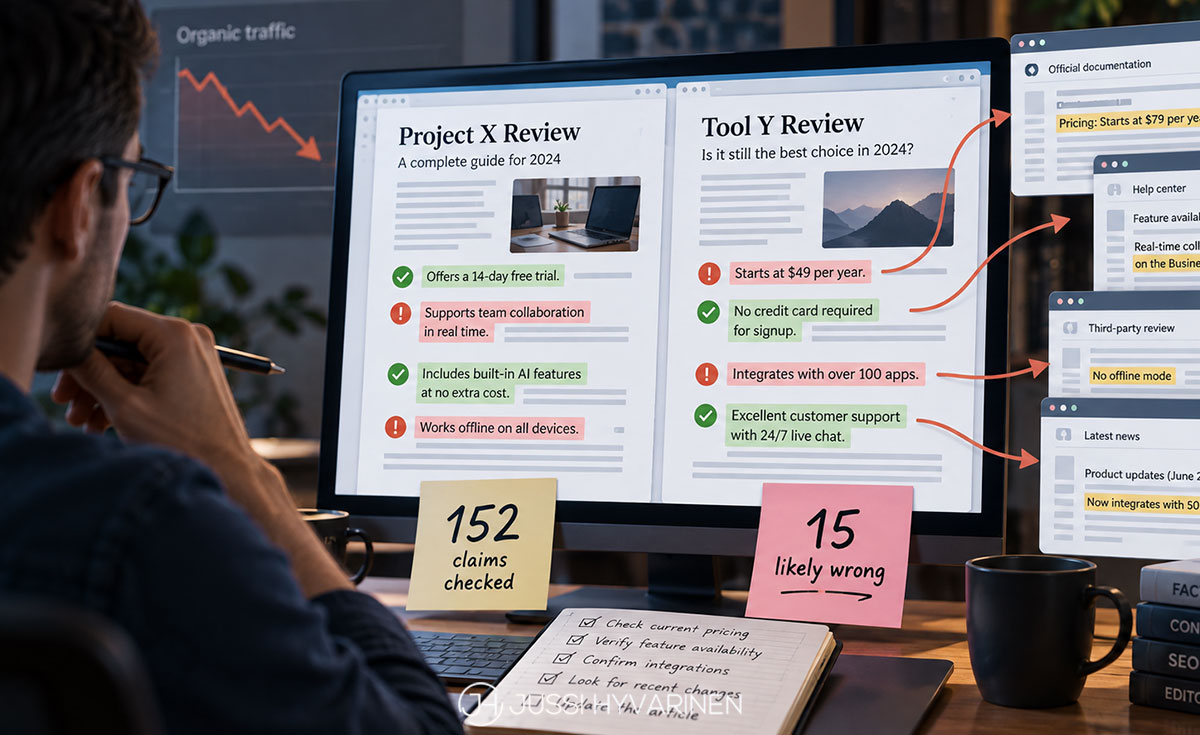


When SEO people talk about content decay, they usually mean a traffic curve: a page that ranked well slowly slides down, and you refresh it to win the clicks back.
There's a second kind of decay that doesn't show up in any traffic report. The page keeps ranking, but the facts in it stop being true. The plan you described gets renamed. The price changes. A limit doubles. Readers who arrive from Google, or from an AI answer that quoted your page, get information that was right a year ago.
Google has just made the facts part harder to ignore. On October 1, 2026, it updated its guidance on generative AI content with this sentence:
"It is critical to manually factcheck and review all AI-generated content for accuracy and trustworthiness before publishing."
Critical, not recommended. The guidance is about checking before you publish, and about AI-written content. But a check on publish day only proves the facts were right on publish day. Whoever or whatever wrote the page, its prices and plans keep changing after that.
I write software reviews on this blog, so I'm more exposed to this than most. I'm also the founder of ProofWrite, and we just built a tool that checks published articles against live sources. Before showing it to anyone else, I ran it on my own reviews.
The test
I picked two reviews that get steady traffic:
- my Lovable review (2,257 words)
- my Clearscope review (2,444 words)
The check read both pages, pulled out every factual claim (152 in total) and checked each one against the products' own pages, their pricing pages as they were that day, and the rest of the web. Every finding came back in one of three groups:
Lovable | Clearscope | Total | |
|---|---|---|---|
Claims checked | 78 | 74 | 152 |
Likely wrong | 11 | 4 | 15 |
Source says otherwise | 1 | 0 | 1 |
Couldn't confirm | 41 | 34 | 75 |
"Couldn't confirm" looks alarming, but it mostly isn't: it covers details no public page states, like how a feature felt to use. Only seven of those 75 were figures, and figures are where most real errors hide. The 15 Likely wrong findings are the ones to read first.
Lovable: the plans that no longer exist
Eleven of the 15 Likely wrong findings were in the Lovable review, and all of them had one root cause. My review described Lovable's pricing like this:
- Starter: $20/month, with 100 additional monthly messages
- Launch: 250 additional monthly messages
- Scale: $100 to $900/month, up to 5,000 additional messages
Lovable's pricing page now lists Free, Pro, Business and Enterprise. Starter, Launch and Scale are gone, and so is every sentence in my review that compared them. Nothing was wrong when I wrote it. Lovable changed its pricing model, and my review kept describing the old one.
The one "Source says otherwise" finding was subtler. I wrote that the free plan gives "5 messages per day (up to 50 messages per month)". Lovable's documentation now describes 5 daily build credits, up to 30 per month. The check couldn't call that wrong outright, because a second read of the sources didn't agree, so it put the finding in its own group and showed me the line from Lovable's docs. That's the right call: it took me a couple of minutes to confirm it myself.
Clearscope: renamed limits, a free trial and a competitor's price
The Clearscope review had four Likely wrong findings:
- Tracking limits. I listed 20 and 50 "AI Tracked Topics" for the two plans. Clearscope now tracks queries instead of topics, and its pricing page lists 50 and 300 Tracked Queries.
- The free trial. I wrote that Clearscope doesn't advertise a free trial. Its pricing page now offers a 14-day free trial.
- A competitor's price. I put Scalenut at $49 to $149 a month. Scalenut's pricing page shows $59 to $199.
Did the check get anything wrong?
Not in what it flagged: all 16 findings held up against the makers' own pages and documentation. That's better than ProofWrite's larger tests, where about three in four Likely wrong findings were real errors, so don't expect a clean sheet on every site.
It did miss some. Going through what it left in "Couldn't confirm" turned up more errors:
- In the Lovable table, it flagged the Starter and Scale prices but not "Launch: $50/month" next to them, or the Scale plan's perks (early access to new features, invitations to VIP events). It also missed "unlimited public projects": Lovable removed public projects in April 2026.
- In the Clearscope review, I had written twice that there's no free trial, and it flagged only one of the two sentences. It also let through my claim that you need separate tools to find topics, although Clearscope's own help center describes built-in keyword discovery and every plan includes monthly topic explorations.
- The one I'm least proud of it didn't flag either. I wrote that "according to user data from independent review platforms", content optimized with Clearscope saw a 52% increase in organic traffic. The 52% is one customer's result, published by Clearscope itself, not aggregate data from review platforms. The check's explanation said as much, but it left the sentence in "Couldn't confirm". That's not decay. That was a sloppy attribution from day one, and no amount of rereading had caught it.
So the flags are worth acting on, and on the pages that matter most, "Couldn't confirm" is worth a read too.
The most useful part wasn't the score, though. Each finding came with the passage from the source, so checking one took a minute instead of a fresh round of research.
How to check your own posts for content decay
You can do this by hand, and for a handful of posts you should:
- Start with the posts that make money or get traffic. Reviews, comparisons and "best of" lists decay fastest, because they're full of prices, plans and limits.
- List the figures first. Prices, plan names, limits, dates and ratings change far more often than descriptions do.
- Check each figure against the maker's own page, not another review. Other reviews copy each other, including each other's mistakes.
- Look at your attributions. "According to X" is a claim too. Make sure X actually says it.
For more than a handful of posts, that's where a tool earns its keep. The ProofWrite check I used reads a sitemap, checks every claim against live sources and ranks the articles by likely errors, with each finding linked to its sentence on the page. New workspaces get 3 articles free, so you can try it on your own worst-aging posts. There's more on how it works in ProofWrite's launch post.
What I'm changing
I'll rewrite the Lovable pricing section around the current Free, Pro, Business and Enterprise plans, fix the Clearscope limits and trial, and replace the 52% sentence with a properly attributed quote.
I'll run the same check again in six months. My guess is that the Lovable review will be the first to decay again, because AI app builders change their pricing more often than anyone else.