

It's already the end of 2025, and if you are still doing SEO the old-fashioned way, you're out of sync with search trends.
Today, SEO rulebooks written for ten-blue-links searches already read like relics. Conversational AI is fast becoming the default path to answers, blending real-time context, personalized suggestions, and natural-language queries.
Join me today as I explore the eight best practices that help forward-looking businesses boost their visibility and find customers in search on ChatGPT.
How AI Chatbots Are Changing the Way We Find Answers
Search boxes now feel like rotary phones. Bain & Company says 80% of consumers rely on AI-written summaries for at least 40% of their queries. That habit isn't a sideshow; it's the main event, reshaping discovery.
Semrush confirms the trend on Google itself. AI Overviews showed up in 13.14% of U.S. desktop searches this March — double January's share. Fewer clicks reach websites, but answers still reach users, straight from large language models.
Enter Generative Engine Optimization (GEO). Content now competes for quotation space inside chat windows, not blue links.
- Chat windows appear before traditional links in everyday how-to questions.
- Brands absent from chats risk invisibility despite solid classic rankings.
- Zero-click searches drain traffic, shrinking revenue projections over time.
- Early GEO adopters secure citation spots that others still overlook.
- Brand trust rises when chatbots quote your insights verbatim.
Move to the new search reality within the next six months, and you'll talk to engines before rivals even notice the microphone. It's a continuous battle for search dominance, and it's not too late for you to win, provided you try hard enough.
The best momentum to change your search optimization routine is today. Adapt now and enjoy compounding visibility while competitors troubleshoot yesterday's playbook.
Six months is short — but it's a generation in search years.
8 Best Practices to Show Up in ChatGPT Answers
Before we dive into my list of the top eight practices to show up in ChatGPT, you should know one thing upfront — no single success path will lead you to the top of the generative engines' search results.
It would be naive and over-optimistic to believe so, given the rapid pace of technological change, particularly in machine learning and neural networks, which continually create both challenges and opportunities.
Nevertheless, master just two or three items here, and you'll be firmly ahead of most competitors in generative discovery.
1. Optimize Content with Clear Headings and Logical Flow
Clear headings are the mile markers that keep readers from getting lost in your content. They help both humans and chatbots understand how each idea fits into the larger picture.
Companies that embraced the GEO-philosophy early have leveraged this to their benefit.
You should follow their lead, and here is how.
Before writing, sketch an outline so every section flows in a sensible order. Think of each heading as a promise you must keep. The body text that follows should deliver exactly what the label suggests — no detours, no filler.
This simple discipline keeps your page scannable and encourages AI models like ChatGPT to treat it as a reliable source.
Some core principles to observe:
- One idea per heading — nothing extra.
- Subheadings explain, not tease or hype.
- Paragraphs build smoothly from point to point.
- Transitional lines guide the reader forward.
- Key details live near the top.
After drafting, read the piece aloud. If you stumble, the flow probably needs work. Trim redundancies, reorder stray sentences, and ensure every section ladders up to the main thesis.
Do that, and both search engines and people will stay engaged until the final line.
2. Get Referenced: Use Backlinks to Signal Authority to ChatGPT
Links remain the internet's stamp of approval, but ChatGPT reads them with fresh eyes. Instead of counting every backlink, it looks for quality signals, topical relevance, and clear anchor text that describe what readers will find.
For ChatGPT, not all links are equal — it elevates sources that are actively prioritizing gaining top backlinks from reputable domains. These authority signals help the model validate your content as trustworthy, which increases the likelihood of your pages becoming the default answers users see in chat-based search.
To help you secure those valuable authority signals, try using tools and tactics such as:
- Ask experts to provide contextual mentions.
- Gather unique data from trusted sources, package it, and pitch to the press.
- Update broken links on high-authority sites with your content.
- Guest on targeted podcasts and include links to show notes.
- Use internal links to strengthen your topic clusters.
After earning a relevant mention, revisit the source yearly. A quick refresh keeps the page alive and your reference intact.
When ChatGPT crawls your pages again, it will still see an active vote for your credibility and surface your pages more often.
3. Include Definitions, Comparisons, and Examples
The logical flow alone won't guarantee you a spot in chatbot search results. Your content must bring real value to the readers by containing topical definitions, useful statistics, ratings, comparisons, and examples.
Let's break the key elements down.
Definitions
A simple definition acts like a flashlight in a dark hallway.
When you mention "semantic clustering," define it on the spot, so readers don't need a side search. That also creates a neat sentence that chatbots can lift verbatim.
Comparisons
Comparisons deepen the lesson.
Set up a two-line contrast between "long-tail keyword" and "conversational phrase," noting why the latter wins in 2025. Short side-by-side statements make differences pop without charts.
Examples
Examples seal the deal.
Tell how an e-commerce brand defined "lifetime value," benchmarked it against average order value, and featured a case where clarifying the metric changed budget plans. Success stories stick, and sticking power is ranking power.
By the way, case studies work even better for that token.
4. Use Conversational Keywords and Long-Tail Phrases
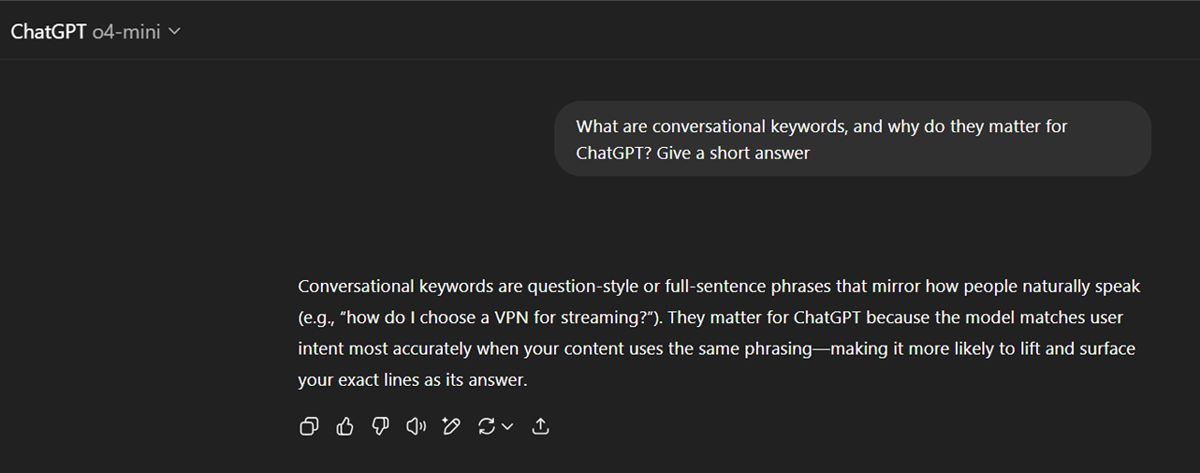
Keywords are not gone in GEO; they just transformed and morphed into the new search behaviors. Avoid keyword stuffing, because that's the relic of the past, pre-GEO world.
Today, chatbot crawlers value long-tail phrases and conversational keywords. They reflect the way people search for information, using conversational queries, instead of short combinations of keywords as in the 90s and 2000s.
Think of long-tail queries as full sentences you'd say aloud. They carry intent, mood, and detail that help ChatGPT match answers with less guessing.
Write the way users speak, and your page becomes the natural reply a bot wants to quote.
A few extra guidelines:
- Mirror real "how do I" questions.
- Add location hints where they matter.
- Use contractions for a friendly tone.
- Keep phrases under fifteen plain words.
- Use short paragraphs, 2–3 sentences long.
- Blend synonyms to widen the surface area and improve discoverability.
Give readers the words they're already thinking, and ChatGPT will deliver your answer without hesitation. Small language shifts today mean steady chatbot traffic tomorrow.
5. Mention Entities, Brands, and Categories with Context
One of the most distinctive characteristics of generative engines like ChatGPT is that they love entities. They literally feed on entities like:
- Names
- Titles
- Brands
- Locations
- Categories
However, names and locations alone can't do the heavy lifting. Context delivers that extra power.
For example, when you mention "Stripe," say it's an online payments leader powering over two million businesses. That extra breadcrumb helps the language model connect dots and answer follow-up questions accurately.
Successful businesses resort to various authority-building tactics, often articulating their best products, lead generation, and other case studies to stand out in ChatGPT results. Give similar context every time you drop a brand, even if it feels obvious to insiders.
The goal is to make the reference useful to readers who arrived cold.
Here's a five-point checklist you can follow each time you drop a brand or category name — use it to give readers and ChatGPT the context they need at a glance:
- Describe each entity's core function in fewer than ten plain words.
- Add a one-line category note, e.g., "HubSpot, a CRM platform, tracks multi-channel outreach."
- Contrast rival categories — e.g., PaaS versus SaaS — within the same breath for clarity.
- Note the regional reach when it changes how a brand serves customers.
- Provide a source link only once (if you have to, reinforce the point without re-linking, so your text reads smoothly).
Remember, accurate context turns name-dropping into teaching. That's the kind of mention ChatGPT loves to quote.
6. Answer Specific Questions in Plain Language
Today's chatbots are nothing like chatbots some ten years ago. They are as smart as a person with a high IQ, depending on the AI model's version (e.g., ChatGPT's 5 model is more capable than the prior 4o) and your subscription (paid users have more intellectual power).
That said, when crawling your content, ChatGPT looks for specific, direct answers that use plain language, much like an intelligent human would.
So, write as if you're chatting with a busy colleague. Strip away filler, speak to one problem at a time, and place the answer where scanning eyes land first.
When the model spots that clarity, it treats your page like a ready-made response.
Save this five-step checklist to always keep your answers plain and pointed:
- Begin each section with the exact user question, verbatim.
- Deliver a one-sentence answer before any extra context appears.
- Swap buzzwords for verbs users actually type or say aloud.
- Break explanations into three-line blocks.
- Link supporting evidence once, then rephrase it link-free later.
Finish by reading your draft aloud. If you stumble, simplify further. Clarity wins citations, and citations win surface time in every chatbot summary.
7. Make Your Content Snippet-Friendly
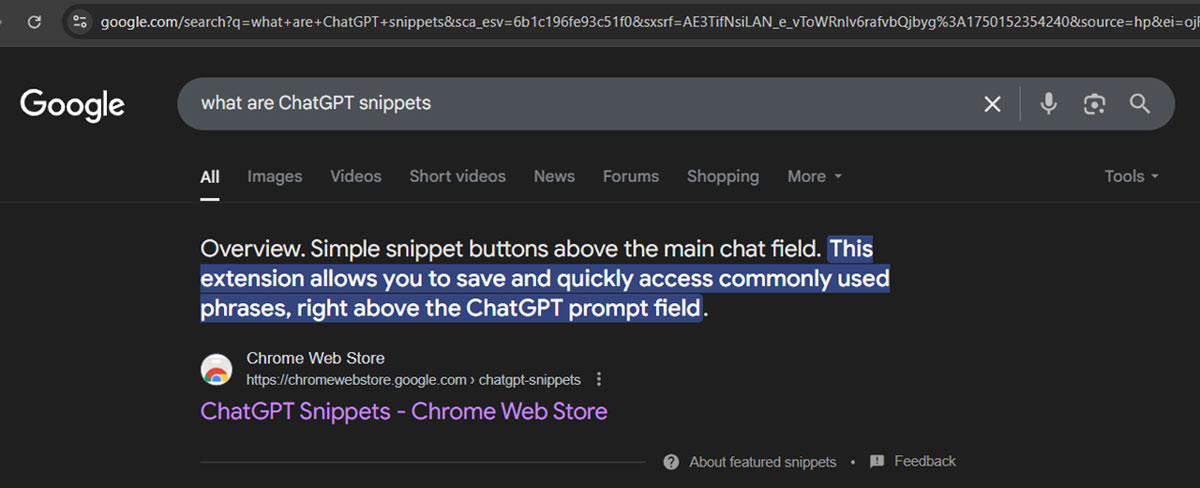
Snippets have traditionally been associated with Google, which has a namesake feature called Featured Snippets (pardon for tautology).
However, in the context of SEO for ChatGPT, by "snippets" we mean any meaningful piece of information whose quality and size make it ideal for this generative model to feature on its front page and in direct answers.
Picture your page as an FAQ sheet: question, answer, done. When every key idea of yours fits that mold, ChatGPT spends less effort editing and more time featuring you. And don't forget to analyze how SEO-friendly your content is before you publish.
Use this micro-blueprint to make your content snippet-friendly:
- Pose the user's exact question as your section heading.
- Follow immediately with a single, direct, one-sentence answer.
- Bold the main term or concept to spotlight the takeaway.
- Add a short bulleted list of supporting facts or steps.
After the answer, show why it matters, e.g., cite a quick result, share a tiny case study. Two sentences are plenty in a world overwhelmed with informational buzz.
Then point to a deeper resource so the curious reader can dig in without cluttering the snippet zone.
Test by copying the first 50 words into a new doc: does it read like a stand-alone reply? If yes, you've struck snippet gold.
8. Optimize for LLM Summarization Patterns
Generative engines reward writers who know how to highlight the gist and write self-contained blocks, like sentences and paragraphs. If a sentence can stand on its own, it can stand inside a chatbot reply.
Draft with that target in mind, and you'll hand ChatGPT the exact lines it needs. The checklist below keeps your structure on track.
1. Front-loading key information
Put your core takeaway in the first sentence or two of each section so the model knows exactly what to lift.
2. Clear Topic Sentences
Put the main takeaway at the start of each paragraph. LLMs often use those as anchor points when summarizing.
3. Strategic Use of Lists
Bulleted or numbered lists are like neon signs to models—they flag exactly which items belong together and are worth lifting whole.
4. Explicit Summaries
Add a short "In summary" or "Key Takeaways" section. When a model sees those cues, it knows to package that text as a concise answer.
5. Consistent Formatting
Use uniform heading levels and simple HTML structures. Models trained on web data recognize those patterns and map them to logical sections more reliably.
If you succeed in making these five points in your daily content marketing habits, consider yourself ideally positioned to win the top ranking in ChatGPT's snippets.
Final Recommendations
In the art of generative engine optimization, it's not enough to reach the top of the competition chain and rest on laurels forever. It's not even possible in modern SEO for ChatGPT.
You are only guaranteed short-term success, but the secret to sustainable peak results is refreshing and updating existing content regularly.
Today, content older than two years is considered moderately outdated; if it's three or more, that's a relic. Especially if it's a technology-focused piece of content, operating with numbers and riding on the trends.
So, just to recap, all eight best practices mentioned in this article are only as good as your desire to keep your content and its optimization practices up-to-date. You must constantly stay on your toes for whatever new GEO trends enter the market, and be keen to adopt them for yourself or your business.