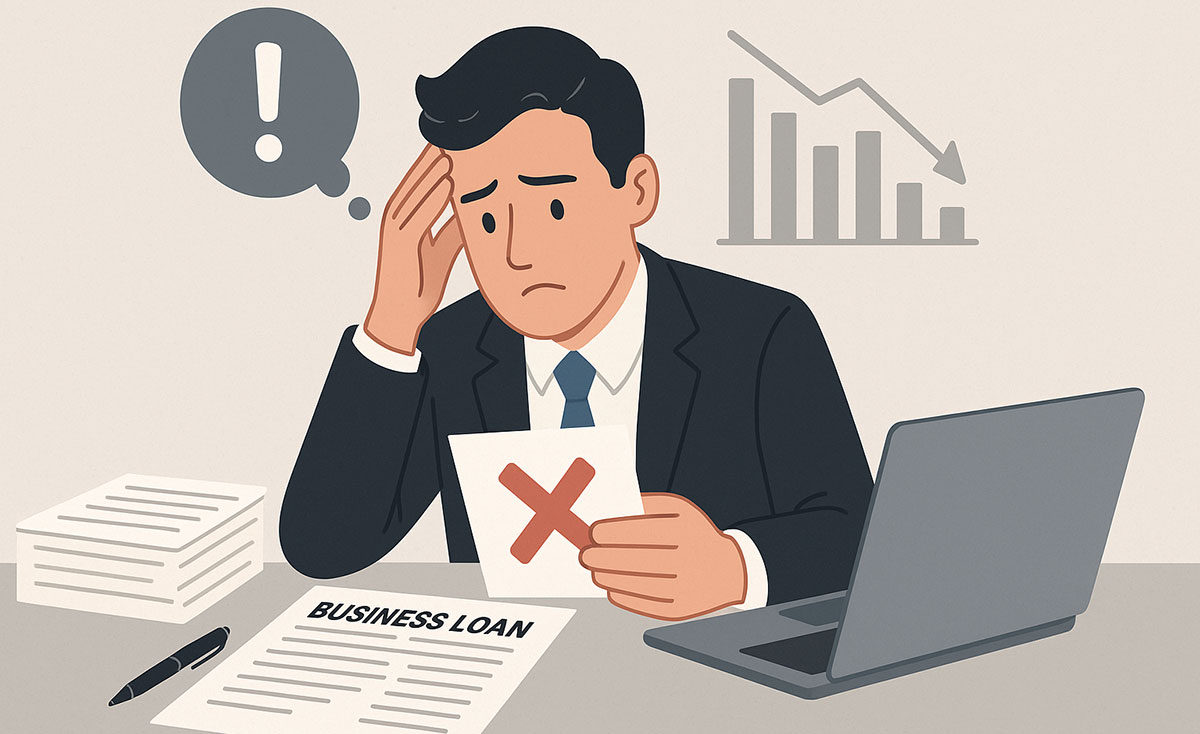


Learn how to get approved for a business loan without the stress.
Entrepreneurs walk into the business loan application process blind, with no clue. They make the same mistakes over and over that cost them thousands in fees and lost opportunities.
The good news is that most of these mistakes are avoidable with a little planning and insight. That's where this guide comes in.
Here's the problem:
Average SMB loan approval rates declined in 2022. Less than one-third of loan applications were funded at full capacity. This means that 70% of businesses got denied or funded at less than the desired level.
And here's the real kicker…
The majority of those denials were due to completely avoidable, small mistakes by business owners.
Mistakes that cost you time, money, and your business growth.
What you'll learn:
- The Credit Score Trap That Kills Applications
- Documentation Disasters You Must Avoid
- Why Your Business Plan Is Getting Rejected
- The Shopping Around Strategy That Works
The Credit Score Trap That Kills Applications
Guess what's the most common issue killing applications?
Personal and business credit scores.
You won't believe this stat: 36% of small businesses denied some funding were rejected because of their credit score. But what most entrepreneurs don't know:
Your personal credit matters just as much as your business credit.
Not only do most lenders review your business credit score before making a decision, but they also deep dive into your personal credit history.
Late payments, collections, and maxed-out credit cards on your personal credit report can torpedo your loan application.
The worst part? Some business owners try to "hide" their personal credit by only focusing on their business credit score.
Bad move, every single time.
Here's what you need to do:
- Check both your personal and business credit reports
- Fix any errors before applying
- Pay down personal credit card balances below 30% utilization
- Don't apply for new personal credit cards right before your loan application
You see, lenders want to see that you're financially responsible in all aspects of your life.
Documentation Disasters You Must Avoid
Did you know the fastest way to get rejected is by submitting incomplete or messy financial documents?
Borrower financials is the number one cause lenders turn to when denying a loan. This is not because businesses don't make money, but because they can't PROVE that they make money.
These mistakes are made all the time. Entrepreneurs are trying to rush their loan application by submitting:
- Tax returns with missing schedules
- Bank statements with gaps
- Profit and loss statements that don't match their tax returns
- Financial projections without any supporting data
The answer is so simple:
Have your accountant prepare a complete financial package before you even start loan shopping. This financials package should include:
- 3 years of business tax returns (complete with all schedules)
- 3 years of personal tax returns (yes, even if you're incorporated)
- Current profit and loss statement
- Current balance sheet
- 12 months of business bank statements
Missing documents make lenders think you're either disorganized or are trying to hide something.
Why Your Business Plan Is Getting Rejected
Here's a common business plan mistake most entrepreneurs make:
Thinking it needs to be a 50-page-long masterpiece, full of industry jargon and "aggressive" growth projections.
WRONG.
Lenders want to see a simple, realistic plan that shows you know your business and market. Fancy formatting and pie-in-the-sky projections don't impress them.
What kills business plans:
- Unrealistic financial projections – Don't claim you'll triple your revenue in year one just because you can.
- No market research – Show that you understand your competition and target market.
- Vague use of funds – Be specific about how you'll use the loan money. No "general business purposes" allowed.
- No exit strategy – Explain how you plan to repay the loan. If you can't, you're going to have a hard time getting approved.
Instead, focus on creating a business plan that shows realistic, conservative growth projections, backed by market research. Explains how the loan will generate enough cash flow to cover payments. Demonstrates your experience and ability to manage a business in your industry.
Keep it simple and honest. Lenders would rather see a conservative plan you can execute than an ambitious plan that's impossible to achieve.
The Shopping Around Strategy That Works
One of the biggest mistakes business owners make when applying for a loan:
Either apply with the first lender they find, or apply everywhere at once.
Both approaches are wrong.
Only applying with one lender can mean missing out on better terms elsewhere. But applying to 20+ lenders at once hurts your credit score, making you look desperate to lenders.
The right way to shop around:
First, research different types of lenders without applying to any:
- Traditional banks – Best rates but stricter requirements
- Credit unions – More flexible but limited loan amounts
- Online lenders – Fast approval but higher rates
- SBA lenders – Government-backed loans with favorable terms
Working with lenders who have experience in small business loans for entrepreneurs and growing businesses can make a big difference in securing favorable terms and approval.
Then narrow down to 3-5 lenders that fit your profile. Compare their typical loan amounts, experience in your industry, speed of funding, and collateral requirements.
And only then, start submitting formal applications.
The Timing Mistake That Costs You Money
Here's the absolute worst time to apply for a business loan:
RIGHT when you need the money BADLY.
When you're in a position of weakness and desperation, you make bad decisions. Accept poor terms and come across as a "risk" to lenders.
Instead, apply for credit when you don't urgently need it. This gives you negotiation leverage to get better terms and the ability to walk away from bad deals.
One pro tip: Set up a business line of credit BEFORE you actually need it.
The Application Mistakes That Scream "Amateur"
Here are some application mistakes that make you look amateur:
Inconsistent information: The loan application doesn't match your financial statements.
Round numbers everywhere: Don't say you need exactly $100,000 in your loan application. Be specific about how much you need for each category: $97,500 for equipment, $15,000 for inventory, $12,500 for working capital, and so on.
Ignoring the relationship part: Build a relationship with your loan officer well before you need money.
The Hidden Costs Nobody Talks About
You know that interest rate? Well, that's just the beginning of your costs. Remember to account for all the hidden fees:
- Origination fees – Typically 1-6% of the loan amount
- Appraisal costs – If collateral is required
- Legal fees – For reviewing loan documents
- Early payment penalties – Some lenders penalize you for early loan payoff
Always ask for the lender's APR (Annual Percentage Rate), which includes all fees, not just the interest rate.
Bringing It All Together
Getting a business loan is not an easy task. It requires preparation and a proper strategy.
Entrepreneurs who get the best terms:
- Prepare their finances months in advance
- Build a relationship with multiple lenders
- Present realistic, well-documented plans
- Know all the costs involved in taking a loan
You see, one in five SMB loan applications was rejected in 2022 despite having good credit scores. Don't let avoidable mistakes put you in that pile of rejections.
The more time you put in up front, the less headache later. Your business deserves the best financing terms, and avoiding these mistakes is how you get them.