

The exact moment when the romance of running an e-commerce business fades often arrives when operational reality takes over. Many solo online entrepreneurs begin by treating physical products almost like digital assets. A polished Shopify store goes live, Facebook and Instagram ads start performing, and orders begin coming in while everything is managed from a laptop in a spare room. At first, it feels almost effortless.
Scaling seems like it should be purely a marketing challenge: increase ad spend, refine the creative, and watch revenue grow. In practice, however, growth often turns into a logistical nightmare. Success can quickly mean being surrounded by stacks of cardboard. What starts in a spare bedroom spills into the garage, and eventually the volume becomes so overwhelming that a move to leased warehouse space and a third-party logistics (3PL) partner becomes necessary.
The transition from digital to physical operations brings a harsh set of challenges that most online business guides barely acknowledge. Those guides spend endless time on customer acquisition costs and conversion rates, yet rarely prepare business owners for misplaced pallets, dead stock draining cash flow, or the profit-destroying cost of shipping a heavy box across multiple carrier zones.
Physical fulfillment is unforgiving. When a digital ad fails, only a few dollars may be lost. When fulfillment fails, the losses are far greater: the product, the shipping cost, the customer, and often the brand’s reputation.
Fortunately, the technology used to manage physical goods has advanced rapidly. Artificial intelligence is no longer limited to enterprise giants with massive supply chain budgets. Today, AI is fundamentally reshaping how small and mid-sized e-commerce businesses handle everything from demand forecasting to warehouse security.
What is AI-Powered Inventory Management?
AI-powered inventory management uses machine learning algorithms to analyze historical sales data, market trends, and supply chain variables to predict exactly how much stock you need and when. It automates restock decisions, helps prevent costly stockouts, and minimizes dead stock tying up your capital.
The End of Guesswork and Dead Stock
When you first start out, inventory management is usually just a gut feeling validated by a messy spreadsheet. You look at what sold last month and order a bit more for next month. But as your product catalog grows, human intuition breaks down.
Dead stock, inventory that sits on your shelves for months or years without selling, is a silent killer of small businesses. It ties up your working capital and takes up physical space that you are actively paying for. Machine learning models tackle this by identifying patterns that are invisible to the human eye.
According to an IBM industry analysis of AI inventory management, these systems continuously ingest massive datasets, learning from sales velocity to dynamically adjust reorder points. Instead of a static "reorder when we hit 50 units" rule, the AI might realize that based on current momentum, 50 units will sell out before the supplier's lead time is up, prompting an earlier purchase order.
Mastering Seasonal Demand Forecasting
Seasonal demand forecasting is notoriously difficult. A human operator might look at last November's Black Friday sales to predict this year's volume. But what if last year's spike was driven by a specific viral social media trend that has since faded? What if your supplier's lead times have increased by three weeks due to global shipping delays?
AI forecasting tools weigh dozens of variables simultaneously. They look at historical seasonality, current website traffic velocity, upcoming promotional calendars, and even broader macroeconomic indicators to generate highly accurate demand curves.
This means you order enough to capture the holiday rush without being left holding a mountain of unsold inventory in January.
Making Sense of SKU-Level Analytics
If you are not familiar with the term, a SKU (Stock Keeping Unit) is the unique identifier for every specific variation of a product you sell. If you sell a t-shirt in three sizes and three colors, that is nine distinct SKUs.
SKU-level analytics means evaluating the performance of every single variation independently. In plain language, it is the difference between knowing "our t-shirts are selling well" and knowing "the medium navy t-shirt is selling four times faster than the large red t-shirt, specifically to customers in the Pacific Northwest."
AI excels at this granular analysis. It prevents you from placing a bulk reorder for all colors when you only actually need to replenish the navy mediums. By automating these micro-decisions, AI ensures your capital is deployed only toward the exact items that will generate a return.
How Does Smart Order Routing Work for Small Businesses?
Smart order routing automatically assigns every incoming customer order to the most efficient fulfillment center or storage location. The AI evaluates shipping proximity, current stock levels, and carrier costs in real-time to ensure the fastest, cheapest delivery possible without manual intervention.
Moving Beyond the Single-Warehouse Model
It is a common misconception that smart routing is only for retail giants with fifty distribution centers. In reality, even small e-commerce operators quickly end up with a hybrid fulfillment model.
You might keep a few racks of your newest product in your garage for quality control and VIP fulfillment, while the bulk of your catalog sits with a 3PL in the Midwest. Or perhaps you use Amazon Multi-Channel Fulfillment alongside your own leased warehouse space.
When an order drops into your Shopify dashboard, who fulfills it? If you make this decision manually, you are almost certainly losing money. As noted in insights from Cahoot on AI agents transforming e-commerce systems, intelligent routing algorithms evaluate the geographic location of the customer against your available inventory nodes in milliseconds.
The Math Behind Fulfillment Optimization
Let's look at the actual math and logic these AI systems execute. Imagine a customer in Dallas orders a heavy cast-iron skillet and a lightweight silicone spatula. You have the spatula in both your home garage in Texas and your 3PL in Ohio. You only have the skillet in Ohio.
A basic, rules-based system might split the order: it sees the spatula is closest in Texas and assigns it there, while sending the skillet from Ohio. You end up paying for two separate shipping labels, two boxes, and two sets of packing materials. Your margin on that order is instantly destroyed.
An AI-powered routing engine looks at the broader picture. It calculates that while the spatula is physically closer in Texas, shipping both items together from the Ohio facility in a single box results in a lower total fulfillment cost. Also, it checks the stock levels in Ohio and verifies that pulling the spatula from that location won't cause a stockout for other pending orders.
This level of fast-changing decision-making, balancing proximity, split-shipment penalties, and inventory buffers, happens entirely in the background. For a business shipping hundreds of orders a month, saving two or three dollars per order through optimized routing translates directly to bottom-line profit.
How Can AI Improve Warehouse Security and Prevent Loss?
AI improves warehouse security by using advanced computer vision to actively monitor your space for anomalies, unauthorized access, and safety hazards. Instead of passively recording video, AI cameras alert you to potential inventory shrinkage, damage, or theft in real-time, effectively automating loss prevention.
The Hidden Cost of Inventory Shrinkage
When scaling up to physical operations, many entrepreneurs are shocked by the reality of inventory shrinkage. Shrinkage is the retail industry term for goods that are lost between the point of manufacture and the point of sale. It encompasses employee theft, external break-ins, accidental damage by forklifts or mishandling, and simple administrative misplacement.
Large retailers build a certain percentage of shrinkage into their financial models; they can absorb the loss of a few pallets. A solo entrepreneur operating on tight margins cannot. If you are selling a high-ticket item with a 20% net margin, losing $1,000 worth of inventory means you have to generate $5,000 in new sales just to break even on the loss. Every missing box represents a direct hit to your personal take-home pay.
Automating Oversight Without a Security Team
I used to think security cameras were essentially digital filing cabinets. They passively recorded footage, and if you realized a pallet was missing three days later, you had the miserable task of scrubbing through hours of grainy video trying to spot the exact moment it disappeared. Who has the time for that while running an e-commerce brand?
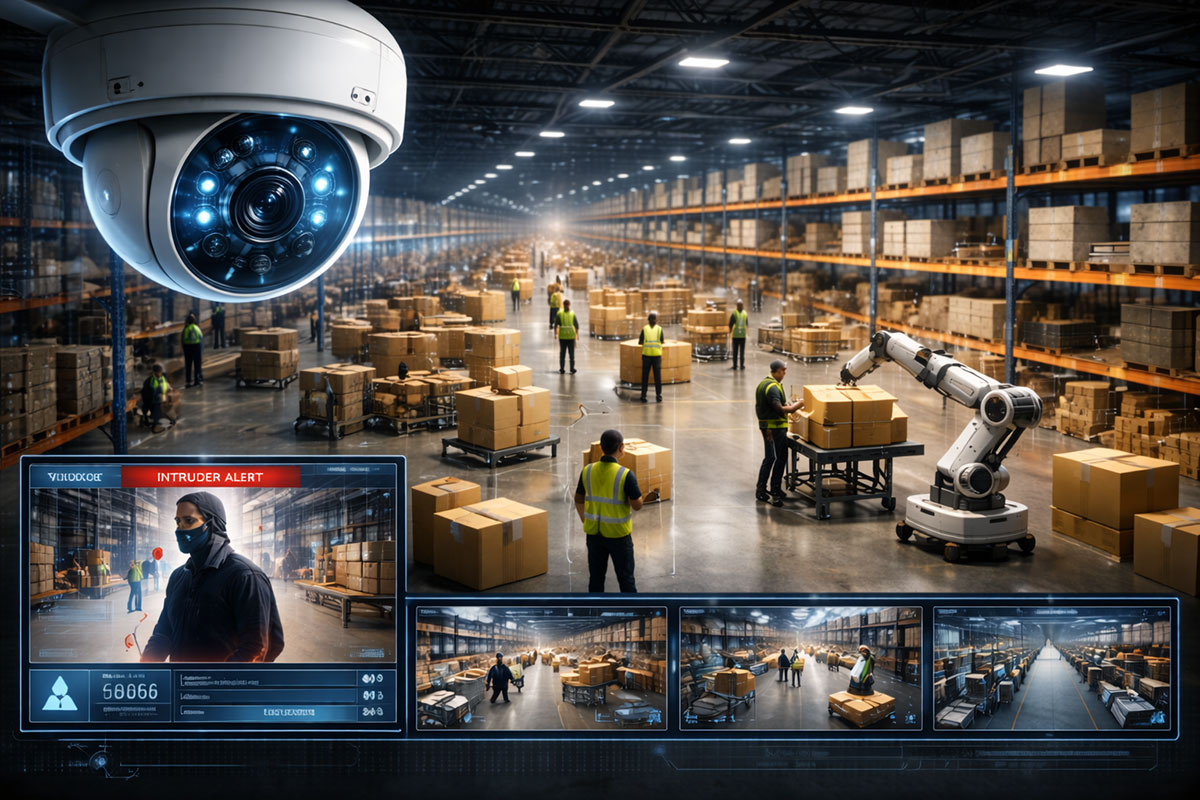
This is where the leap from traditional cameras to AI vision technology changes the game. Modern systems do not just record pixels; they understand what they are looking at. Deploying a modern warehouse security camera system has become surprisingly accessible for small business owners transitioning into their first dedicated physical spaces.
Companies like Coram AI provide systems that act less like cameras and more like digital security guards. The AI engine processes the video feed in real-time to detect anomalies. If a person enters a restricted high-value inventory cage after operational hours, the system immediately flags it. If a forklift collides with a racking system, the AI recognizes the event and logs it.
More importantly, AI makes video searchable. Instead of fast-forwarding through a weekend's worth of footage, you can literally search the system for "person wearing a red shirt in aisle four on Sunday" or "box removed from bay 12." You gain enterprise-grade loss prevention and operational oversight without hiring a dedicated security guard to stare at a bank of monitors.
Presenting this technology as merely "security" understates its value; it is an operational audit tool that protects your margins and gives you peace of mind when you aren't physically in the building.
Practical Next Steps: How Should You Prioritize AI Tools?
You should prioritize AI tools based on your current operational scale and primary pain points. A business shipping fifty orders a month needs different solutions than one shipping five hundred. Start by assessing where you lose the most time or money, then adopt technology incrementally.
The 50 Orders Per Month Phase: Focus on Visibility
When you are shipping a couple of orders a day, your primary enemy is usually stockouts. At this stage, complex multi-node order routing is overkill because you likely only have one storage location. Likewise, enterprise security might not be necessary if everything is still sitting in your locked garage.
Your priority here should be AI-assisted inventory management. Look for lightweight tools that integrate directly with your e-commerce platform (such as Shopify or WooCommerce) to help you accurately forecast demand.
The goal is to stop relying on spreadsheets and gut feelings. Getting comfortable with SKU-level analytics early on lays a foundation of clean data that makes scaling much easier later.
The 500 Orders Per Month Phase: Focus on Optimization and Protection
As you cross into hundreds of orders per month, the operational friction changes. You are likely utilizing a 3PL, managing multiple supplier relationships, and holding significant capital in physical goods.
This is the point where smart order routing becomes mandatory. If you are fulfilling from multiple zones, an AI routing engine will pay for itself in saved shipping costs within the first few months. Simultaneously, this is the stage to seriously evaluate your loss prevention strategy.
When you have thousands of dollars of inventory sitting in a leased space, upgrading to an AI-powered security camera system moves from being a luxury to a baseline necessity. You need the ability to audit operations remotely and ensure your physical assets are protected against shrinkage.
A Quick Self-Assessment
If you are unsure where to direct your technology budget, ask yourself these three rhetorical questions:
- Am I tying up too much cash in dead stock while constantly running out of my bestsellers? If yes, prioritize AI inventory forecasting.
- Are split shipments and high-zone carrier rates destroying my per-order profitability? If yes, prioritize smart order routing.
- Am I losing track of physical goods, experiencing unexplained damage, or feeling blind to what happens in my facility when I am not there? If yes, prioritize AI computer vision and warehouse security.
The beauty of the current technological landscape is that you do not have to build these systems from scratch. As highlighted by Forbes in their coverage of how AI is transforming e-commerce logistics, these capabilities are increasingly available as plug-and-play software-as-a-service (SaaS) products. You can bolt them onto your existing operations one by one.
Scaling an e-commerce business will always involve growing pains. Moving from digital marketing into physical fulfillment will test your patience and your cash flow. But by leveraging AI to handle the complex, data-heavy tasks of inventory prediction, routing math, and security oversight, you can get back to doing what you do best: building your brand and selling great products.
Frequently Asked Questions
Is AI fulfillment technology too expensive for small e-commerce businesses?
No, AI fulfillment technology is no longer prohibitively expensive. Many modern AI inventory and routing tools are offered on a Software-as-a-Service (SaaS) model, charging a manageable monthly subscription or a small fraction of a cent per transaction, making them highly accessible for solo operators.
Do I need to know how to code to use AI inventory tools?
You do not need any coding knowledge to use modern AI inventory tools. These platforms integrate directly with popular e-commerce platforms like Shopify or BigCommerce through simple, click-to-install apps, featuring intuitive dashboards designed for business owners rather than developers.
How quickly can AI forecasting adapt to sudden viral trends?
AI forecasting models can adapt to viral trends almost immediately by ingesting real-time website traffic, social media mentions, and sudden spikes in sales velocity. Unlike traditional models that wait for end-of-month data, AI adjusts reorder recommendations dynamically to help you capture sudden demand.
Can AI security cameras integrate with my existing warehouse hardware?
Many AI security platforms can integrate smoothly with your existing IP camera hardware. Rather than forcing you to rip and replace all your physical cameras, these systems often use a local edge-processing device that connects to your existing network to add AI-powered computer vision to standard video feeds.
Enter your text here...