

Search Atlas launched in 2024 as an all-in-one SEO (Search Engine Optimization) and content marketing platform. It positioned itself as an affordable, AI-driven alternative to other established tools.
The platform defines itself as an “AI-powered SEO automation platform” for agencies and teams. It includes more than 40 integrated tools for keyword research, site auditing, rank tracking, content optimization, backlink analysis, and related workflows.
Search Atlas differentiates itself with OTTO, its built-in AI assistant. OTTO does more than recommend optimizations. It implements on-page and technical changes directly on connected websites.
The platform uses vast datasets—about 5 billion keywords and 100 trillion backlinks across 200 countries—to generate insights.
Marketing agencies benefit from multiple user seats under one subscription and a full white-label dashboard branding for client reporting. New users test the platform through a 7-day free trial supported by a 30-day money-back guarantee.
Search Atlas is a comprehensive SEO platform that simplifies SEO workflows through automation and provides an extensive toolkit at a lower cost than traditional platforms.
SEO Tools and Features
Search Atlas delivers a comprehensive SEO toolkit. Use it to research keywords, audit site health, analyze backlinks, and track rankings. Below you can review key features.
AI SEO with OTTO SEO
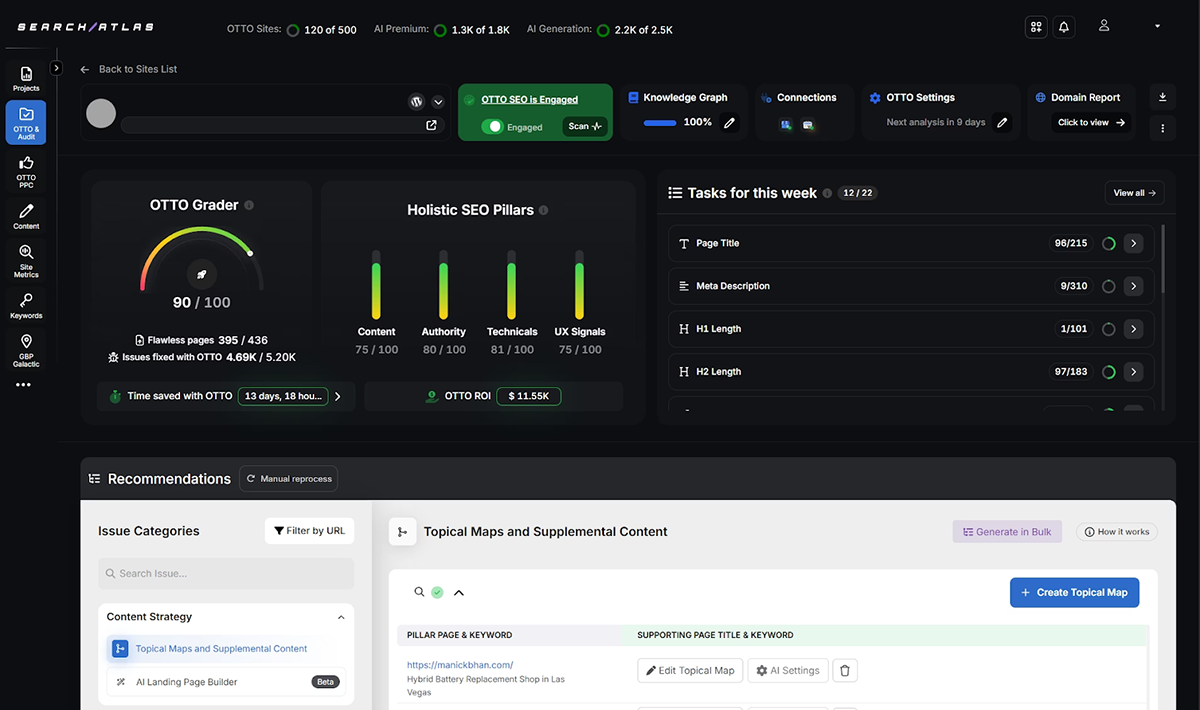
OTTO SEO serves as the automation engine that elevates the platform above traditional dashboards.
Rather than only surfacing technical issues or keyword gaps, OTTO executes fixes, generates ongoing recommendations, and applies changes directly through CMS integrations or the OTTO tracking pixel.
OTTO functions as an always-on AI SEO Agent that reduces the manual loops that slow progress. For instance, while a standard audit tool flags missing schema markup, OTTO inserts structured data automatically across relevant pages. The system not only identifies problems—it resolves them in real time.
For example, where a traditional audit tool might flag “missing schema markup,” OTTO SEO can insert the correct structured data across pages automatically. It doesn’t just highlight problems—it solves them.
Keyword Research
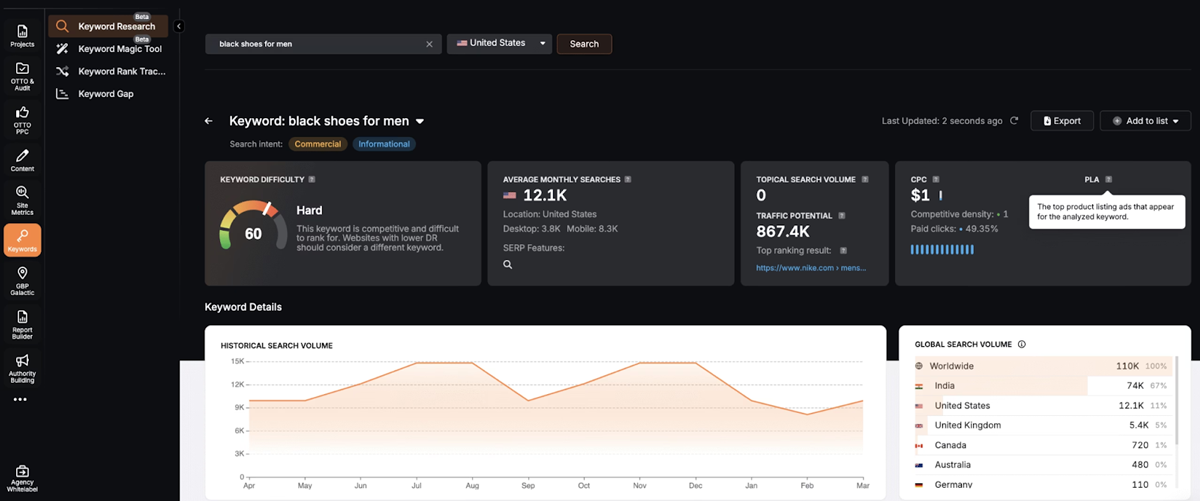
Search Atlas delivers advanced keyword research through its Keyword Researcher and Keyword Magic Tool. The database spans more than 5.2 billion keywords and supplies metrics such as monthly search volume, cost-per-click (CPC), keyword difficulty, and estimated user intent for every query.
Enter seed keywords and generate expansive lists of related terms. The tool surfaces long-tail variations, questions, and alternative phrasings. Each keyword comes with supporting data that reveals search volume, competition, and SERP intent, enabling you to rank priorities for SEO or PPC campaigns.
Expect Search Atlas to report different numbers compared to other platforms. For example, the keyword “SEO books” shows 4.4K searches per month, while other providers estimate more than double.
Search Atlas classifies the intent as informational, while competitors often label it mixed (informational plus transactional). This difference reflects the platform’s reliance on Google Search Console data, which favors accuracy over inflated clickstream estimates.
Use Search Atlas to discover keywords, evaluate difficulty, group topics, and analyze competitor rankings. Treat the metrics as directional indicators, which is the best practice with any SEO platform.
Rank Tracking
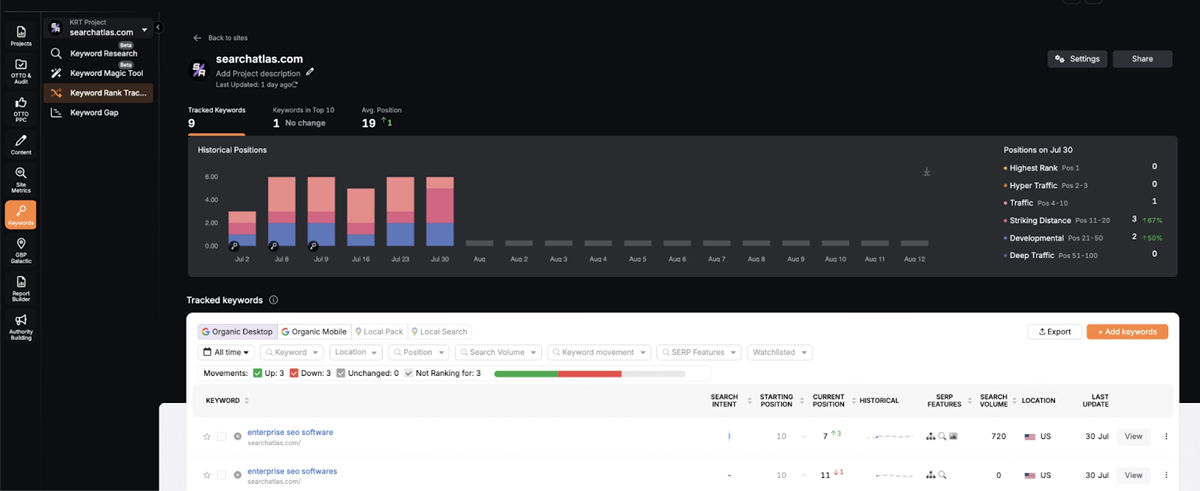
Search Atlas excels in rank tracking by updating keyword positions daily, while many tools refresh weekly. The dashboard displays rankings across desktop, mobile, and local search in a single view.
Integrate directly with Google Search Console to pull first-party data and reduce errors from scraped SERP proxies. The rank tracker highlights which SERP features—such as snippets, maps, or videos—appear for each keyword and shows whether your site ranks in them. This provides visibility beyond blue links.
Segment results by country, region, or city to measure geographic differences and support local SEO. Daily updates allow SEO teams to spot ranking drops or gains quickly, react to algorithm shifts, and measure the impact of optimizations in near real time.
Weekly updates from lower-tier tools delay insights, while Search Atlas delivers precise, timely tracking for agencies and teams that manage multiple campaigns.
Site Audits and Technical SEO
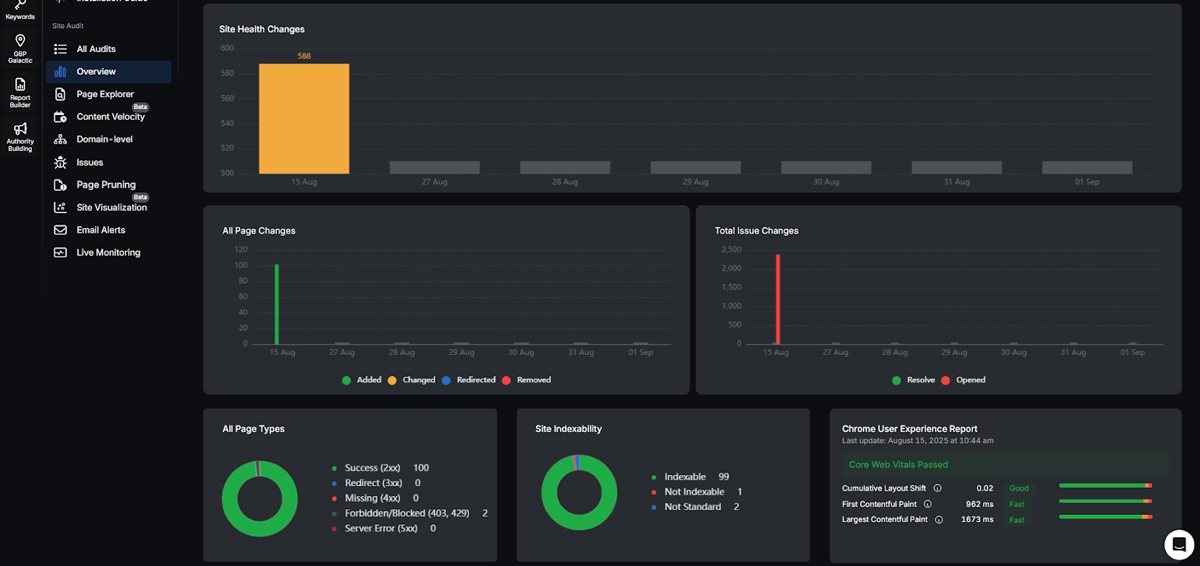
Search Atlas delivers technical SEO insights through its Site Auditor, which performs full-site crawls and on-page audits in real-time. The platform prioritizes immediate scanning rather than the slow weekly or monthly cycles common elsewhere.
Install the OTTO tracking pixel, and the system begins continuous monitoring. The Site Auditor flags broken links, redirect chains, missing or incorrect meta tags, slow load times, blocked resources, and indexability problems. It also detects nuanced issues such as missing schema markup or conflicting index directives that reduce visibility.
The platform generates a prioritized task list with fix-it guides, so you can address the most impactful errors first. Alerts appear as soon as new issues arise, which means you discover problems without delay.
Search Atlas also includes an On-Page SEO Audit that analyzes individual pages, scores their optimization, and recommends specific content or technical improvements. Together, these tools act as a real-time safeguard for site health and provide clear steps for optimization.
Content Marketing Features
Beyond technical SEO, Search Atlas offers a range of content marketing tools to assist with planning, creating, and optimizing content for improved rankings. These features are especially useful for content teams and SEO-driven content marketers.
Topic Research and Content Planning
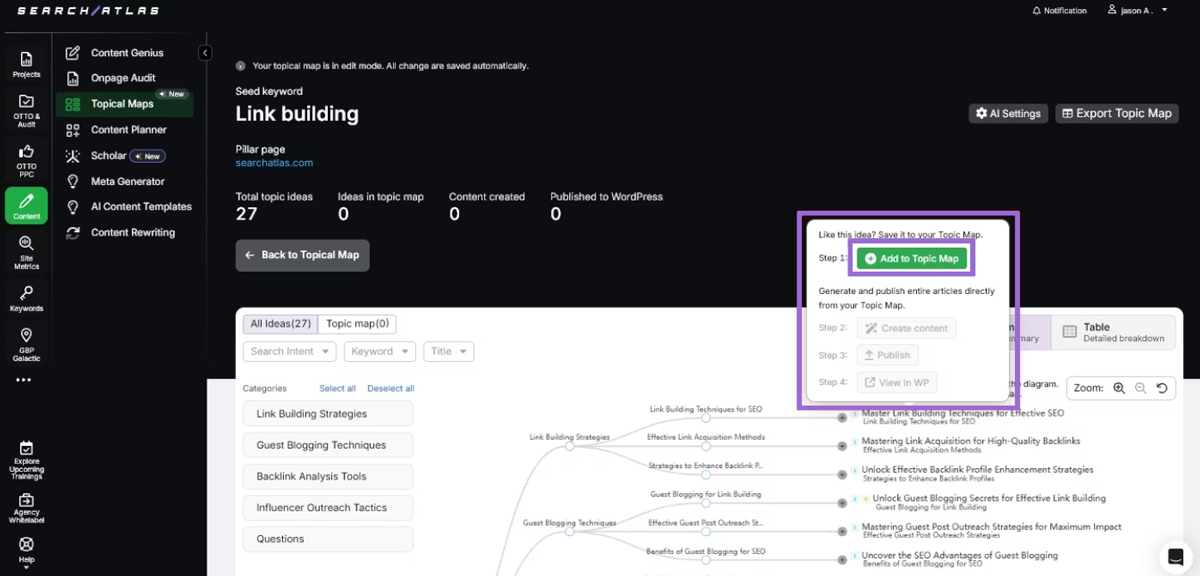
Use the Content Planner module and Topical Map Generator to design effective content strategies. The Content Planner accepts a seed topic or keyword and produces a structured plan around it.
AI-driven keyword clustering organizes related terms into more than 300 topic clusters grouped by semantic similarity and search intent.
For example, enter email marketing as the seed keyword and receive clusters such as email marketing best practices, newsletter design tips, and email automation tools. Each cluster includes subtopic keywords with search volumes and difficulty levels. This structured approach enables you to build a content calendar that covers every major angle of a topic.
The planner analyzes homepage content and target regions to highlight the most relevant, high-impact topics. Teams gain an editorial roadmap aligned with SEO results.
Run the Topical Map Generator to create detailed outlines. Provide a primary topic, and the tool generates subtopics, long-tail keywords, and suggested titles for each cluster. Export the output as a spreadsheet, then assign tasks to writers or track progress easily.
Topical maps reveal how to cover themes in depth—what articles to write and how they connect—ensuring you establish topical authority. Combined, the Content Planner and Topical Map Generator form a full editorial calendar framework.
Organize and schedule projects directly within the integrated workflow, then move seamlessly from research to ideation to publishing. These planning features reduce hours of manual work and anchor strategies in data from the start.
Content Optimization and AI Writing
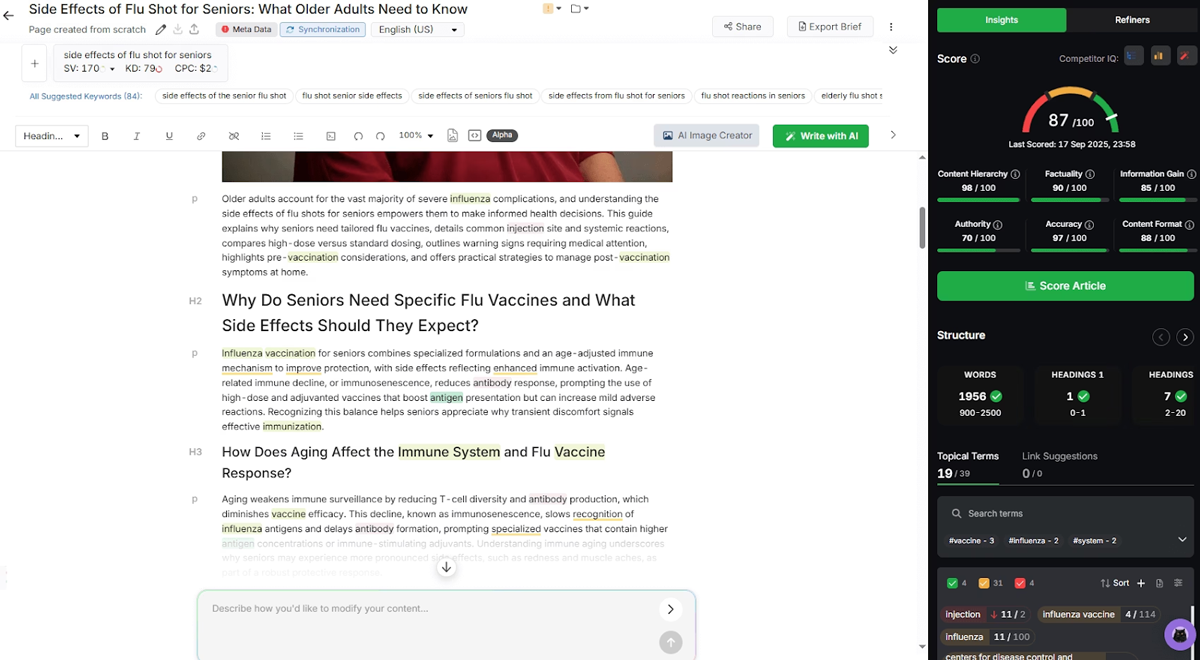
Access Content Genius, Scholar, and an AI Content Writer to write and optimize content effectively. Content Genius serves as an AI-driven editor, scoring drafts in real-time. It evaluates keyword use, semantic coverage, structure, and clarity, then suggests improvements that align with SEO best practices and user expectations.
Scholar acts as a semantic analysis tool. It measures how well text covers a topic by assessing relevance, language complexity, and comprehensiveness. Treat this as a pre-publication audit for content quality.
The platform also includes an AI-powered Meta Tag Generator. Generate optimized page titles and meta descriptions at scale, following best practices for keyword placement, length, and click-through appeal.
For creation, the AI Content Writer offers over 55 templates for blog posts, ad copy, emails, product descriptions, and social media updates. Select a template, enter details such as keywords, tone, and audience, then receive a draft ready for refinement.
Unlike many template-based writers, this tool supports deep customization. Establish project-level guidelines to enforce a consistent brand voice across all content, or refine instructions for individual pieces.
The AI handles short rewrites, full-length articles, and even auto-generated Google Business Profile posts with AI-created images.
While human editing remains essential, these tools dramatically accelerate production. Search Atlas supports the entire lifecycle: research, drafting, optimization, and publishing.
Teams that need to scale output while maintaining quality and visibility benefit most from this integrated approach.
Link Building Tools
Search Atlas reduces the time required for link acquisition by bundling discovery and outreach tools. The platform includes backlink gap analysis, a digital PR module, and an AI-driven link exchange network.
Backlink Analysis
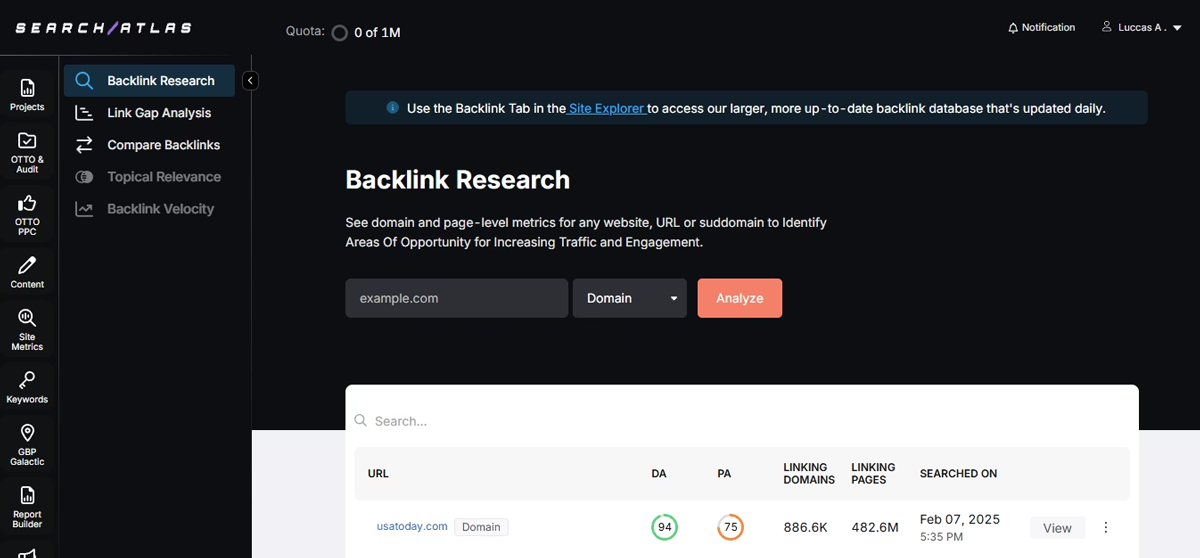
Search Atlas maintains one of the industry’s largest link indexes, with more than 100 trillion backlinks across 500 million domains. The Backlink Analyzer enables in-depth exploration of any domain’s link profile.
Review totals for backlinks and referring domains, monitor gains and losses, and investigate anchor text, link placement, and follow attributes.
The system calculates Domain Power, a proprietary authority score that incorporates Google Search Console data on organic traffic and rankings. By factoring in actual performance signals, Domain Power offers a more realistic view of influence than raw link counts.
Benchmark your domain against others by running side-by-side comparisons, or use Backlink Gap Analysis to uncover missed opportunities. This data highlights where competitors gain an edge through stronger backlinks and where you can secure new placements.
Backlink Gap Analysis
Use the Backlink Gap tool to compare backlink profiles across as many as six domains. Identify domains linking to competitors but not to your own site, then target them for outreach. These sites already recognize value in your niche, so they represent high-probability opportunities.
View overlapping and unique referring domains for each site, along with authority metrics and spam indicators. Prioritize outreach to quality sources that can transfer real authority. The feature highlights where competitors gain link equity and guides your own campaigns toward those domains.
Outreach and Digital PR
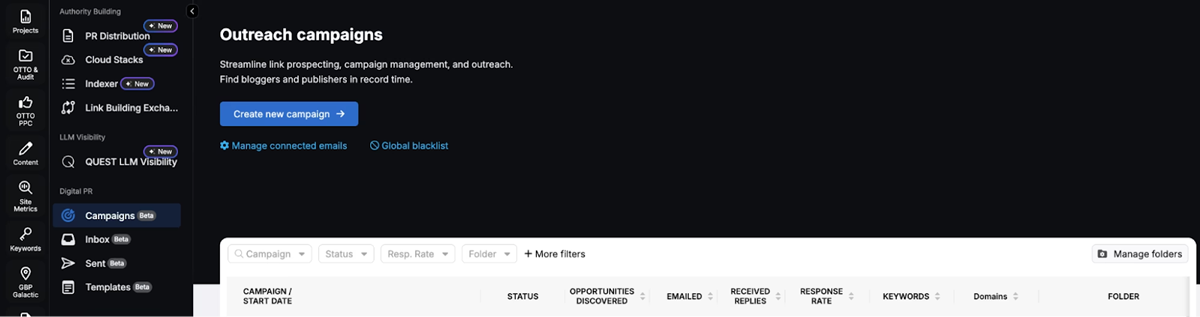
Search Atlas provides a built-in Link Building Outreach and Digital PR tool that manages outreach from start to finish. Operate from a single dashboard to identify link prospects, send personalized outreach emails, and track responses.
The tool filters and suggests prospects by niche relevance, domain rating, traffic, and region. It blocks duplicate efforts with a shared blacklist that excludes unsuitable or previously contacted sites.
Automated Link Exchange Network
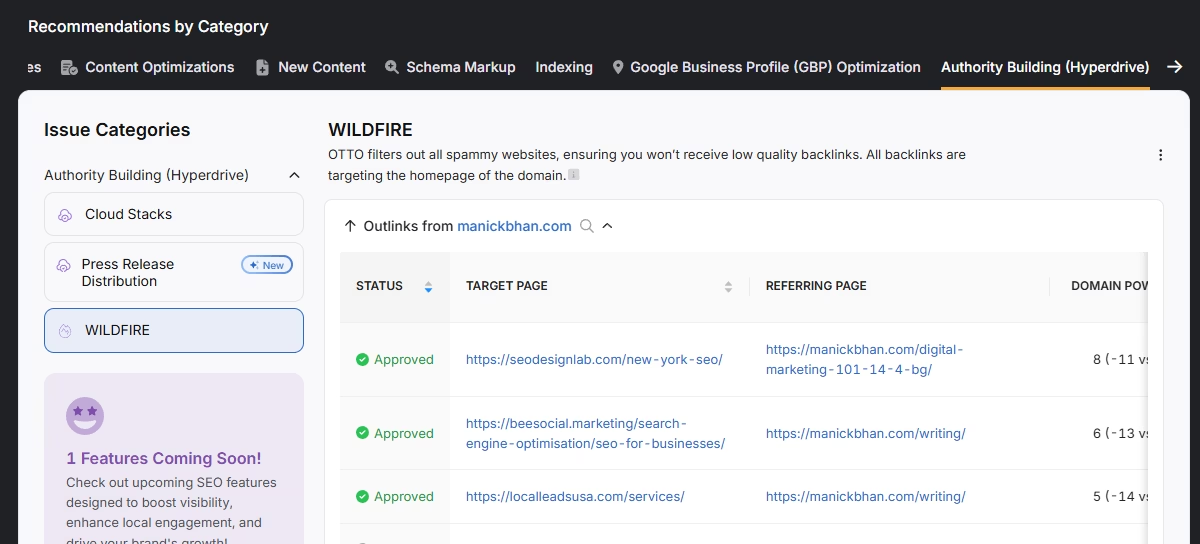
Search Atlas offers WILDFIRE, an AI-powered backlink exchange network. Exchange two outbound links to receive one inbound link from a trusted, topically aligned site.
WILDFIRE’s algorithm matches your site with domains of similar quality and topical relevance, ensuring contextual exchanges rather than spammy links. The system reviews proposed matches before approving any exchange.
Sites gain quality backlinks more quickly without relying only on manual outreach or paid links. WILDFIRE generates as many as 10 backlink opportunities per week per site and automates partner discovery and negotiation.
Agencies and website owners who embrace controlled link swaps gain speed and efficiency while still aligning exchanges with Google’s guidelines.
Competitive Analysis Features
Competitive analysis drives effective SEO strategy, and Search Atlas equips teams with tools that benchmark performance against competitors.
The main resources include the Site Explorer for domain overviews and the Keyword Gap Analysis for portfolio comparisons, supported by competitor backlink insights.
Site Explorer
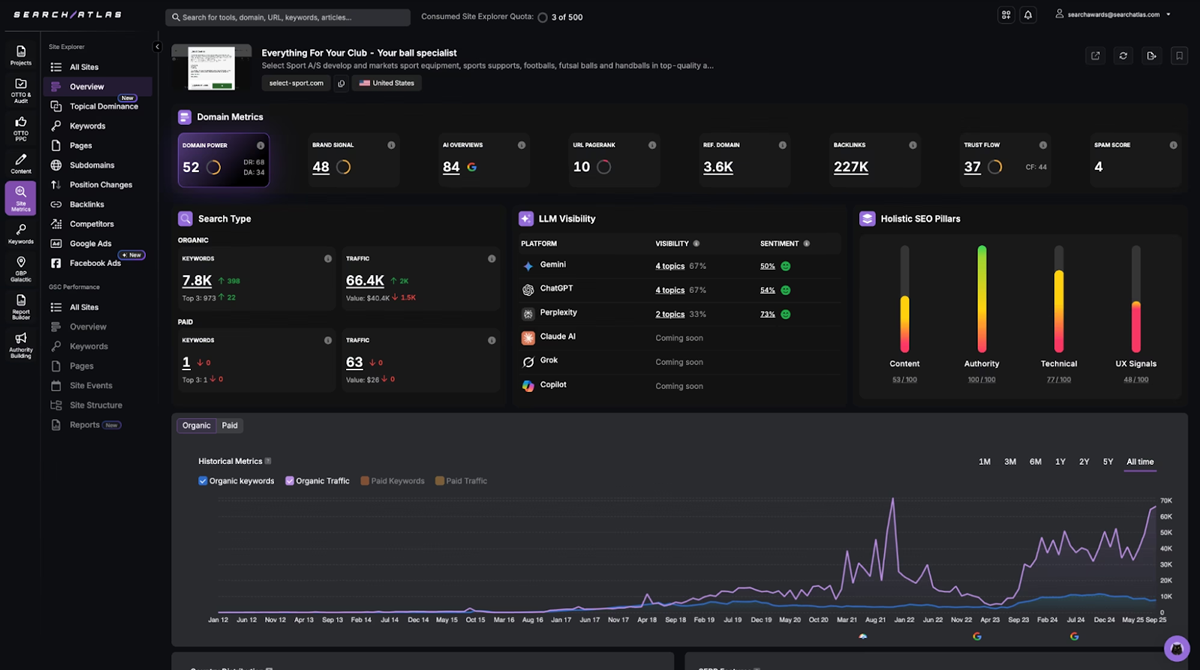
Use Site Explorer to view a complete overview of any domain in search. Enter a competitor domain or your own and receive a dashboard of metrics that summarize organic rankings, estimated traffic, backlink profile, and authority scores.
Review the number of ranking keywords, the highest-performing terms, and the distribution across the top 3, top 10, and beyond. Check total organic traffic and Domain Power to measure actual strength in Google results. Analyze backlinks with referring domains, growth timeline, anchor text cloud, and spam probability indicators.
Choose scope by root domain, subdomain, or exact URL. Switch between countries to analyze international competitors or site sections. Track historical data to identify traffic spikes after campaigns or updates, or to measure backlink acquisition trends over time.
Site Explorer provides a fast, at-a-glance competitor profile and tracks your own position against the market.
Keyword Gap Analysis
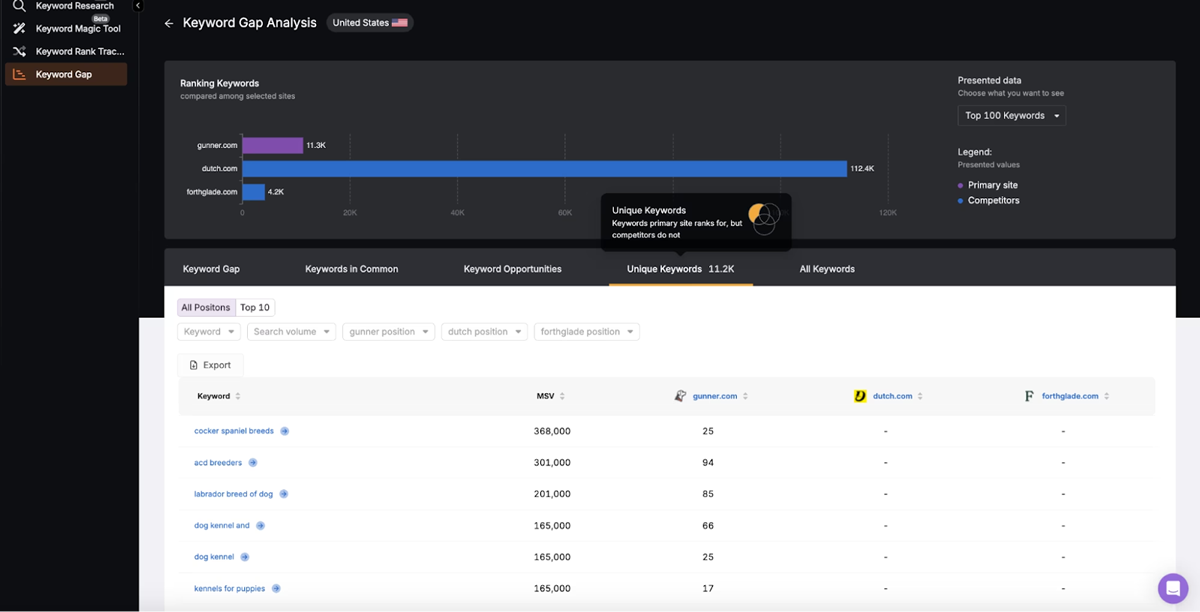
Run Keyword Gap Analysis to compare your keyword portfolio against up to five competitors. The tool organizes results into clear segments: keywords competitors rank for but your site misses, shared keywords across all sites, and keywords unique to you.
Spot immediate opportunities by finding high-volume keywords that only competitors target. Evaluate each gap with metrics such as search volume, ranking difficulty, and intent. Narrow results with flexible filters and analyze real-time SERP data to reflect the current competitive landscape.
Utilize the tool to reverse-engineer your competitors' strategies. Identify content areas where rivals hold the edge, then optimize or build new content to compete.
Protect existing rankings by monitoring overlap in “Keywords in Common.” This analysis acts as a roadmap that closes gaps, protects strongholds, and reveals high-value opportunities others capitalize on.
Usability and User Experience
Evaluate an SEO platform based on how smoothly it works in daily use. Search Atlas presents a clean, intuitive dashboard that reduces friction. The interface resembles other popular tools, which helps users adapt quickly without a steep learning curve.
Navigate the platform through a left-side menu that organizes features into sections such as Keywords, Content, Backlinks, and Site Audit. Each section groups related functions in a logical way. Tooltips and embedded explanations highlight clarity and prevent clutter, which allows even beginners to find their way.
Experience fast data retrieval throughout the platform. Guided integration with Google data sources simplifies setup for Search Console and Analytics. The straightforward process shortens the learning curve so new users begin optimizations soon after signing up.
Report Builder
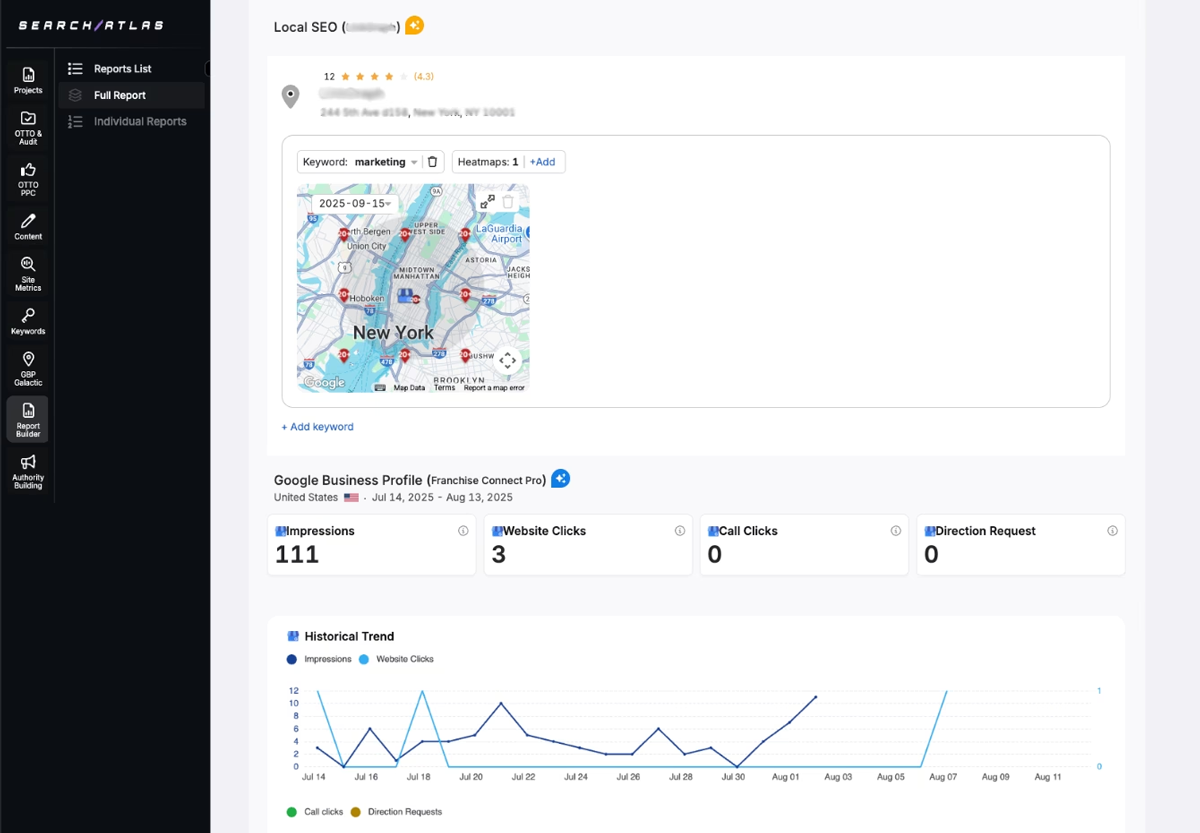
Create and deliver client-ready reports without friction. Search Atlas features custom dashboards and white-label reporting, tailored specifically for agencies. Build client-specific views that highlight relevant metrics—for example, local SEO trends for a small business or content KPIs for a publishing campaign.
Apply agency logos and color schemes directly to reports. Clients see polished dashboards without Search Atlas branding, which maintains a professional image. Export reports in multiple formats: generate PDFs for presentations, export CSVs for analysis, or sync data to Google Sheets for live dashboards.
Filter and customize every data view before generating a report. Show mobile rankings in a region or highlight technical issues above a severity threshold. Agencies benefit from included white-label features and multi-user access across all plans—services that competitors often lock behind premium tiers.
Customer Support
Access a knowledge base with tutorials and articles that guide users through each tool. Search Atlas also provides forums and groups where the community shares tips and answers questions.
Expect official support to respond quickly and professionally. Early feedback shows mixed experiences. Some users praised responsive communication and feedback tracking, while others criticized delays and a lack of updates on new features. Reports also noted occasional bugs and glitches, which the team continues to patch with regular updates.
Recognize that Search Atlas evolves rapidly. Frequent updates expand features and improve stability, yet a few rough edges remain. Agencies and professionals who prioritize modern design and flexible reporting will find strong usability.
Those who expect flawless stability from the outset should note the early reports before making a decision.
Pricing Plans and Value for Money
Search Atlas provides three subscription tiers with monthly pricing and discounts for annual billing.
- Starter – $99/month: Start with two user seats and manage up to five domains. Access all core tools: keyword research, rank tracking, site and content audits, backlink analysis, OTTO AI automation, Google Search Console integration, and Google Business Profile management. AI content creation and local SEO come included. This plan fits individuals or small teams who want to collaborate directly inside the platform.
- Growth – $199/month: Expand limits on projects, queries, and keyword tracking. Gain multiple user seats and scale content planning with OTTO AI across campaigns. Agencies with moderate client loads and in-house teams managing several sites benefit most from this plan.
- Pro – $399/month: Use five seats by default and extend to larger teams. Track a high volume of keywords and projects, with unlimited Google Search Console connections. Pro includes advanced white-label reporting, API access, and priority support. Larger agencies and enterprises handling many websites get full functionality without add-on charges.
Every plan includes OTTO AI features, one-click publishing to WordPress, and integration with Google Search Console. Transparent pricing avoids hidden seat costs or paid add-ons. Search Atlas offers a 7-day free trial and a 30-day refund window.
Although no forever-free plan exists, the Starter tier delivers strong value by combining automation, content tools, and local SEO management at the entry level.
Alternatives to Search Atlas
Search Atlas enters a crowded field of SEO and marketing platforms. Here are some notable alternatives and how they compare:
Semrush vs Search Atlas
The most direct comparison, Semrush, is a veteran all-in-one SEO/SEM suite with a very broad feature set (over 55 tools) covering SEO, PPC advertising, social media, and competitive research.
Semrush has one of the largest keyword databases and a highly trusted data history, plus extras like a content marketplace and an app center of add-ons.
It tends to have more polished reporting and integrations, and its long track record means data reliability is proven (e.g., frequent database updates and stable tools).
Semrush is quite expensive, and many of its advanced features (e.g., additional users, white-label PDF reports, or writing assistant credits) incur extra costs.
Ahrefs
Ahrefs specializes in backlink data and content research. Its backlink index holds around 35 trillion links, slightly below Search Atlas. Strong site exploration tools make it excellent for analyzing competitor backlinks and rankings.
It offers reliable keyword research and audits, but lacks AI automation. Pricing runs high and charges by seat, so agencies often pay more. Choose Ahrefs if backlink analysis is your top priority.
Moz Pro
Moz delivers keyword research, link analysis, audits, and rank tracking. It introduced the popular “Difficulty” metric and unique scores like Page Authority and Spam Score. Its interface is simple, and its learning resources stand out.
However, Moz updates data more slowly and has smaller databases than Search Atlas. It suits beginners or small businesses that want guidance over raw power.
SE Ranking
SE Ranking positions itself as a budget-friendly suite. It includes daily rank tracking, audits, keyword research, and a marketing plan builder. Its limits are generous for the price.
It lacks AI automation, but covers core SEO tasks well. SE Ranking is ideal for users who prioritize affordability and reliability over advanced automation.
Surfer SEO
Surfer focuses on content optimization. It generates guidelines for word count, keyword usage, and NLP terms based on top pages. Integrations with Google Docs and a built-in planner support content teams.
Surfer does not include backlink or rank tracking features, so teams often pair it with other tools. Pricing rises with higher content needs.
Who Should Use Search Atlas (and Who Might Not)
Search Atlas is best suited for the following:.
Agencies and SEO teams managing multiple sites
Agencies gain built-in collaboration features. The base plan includes 2 seats, Pro includes 5, and teams share a white-label dashboard to present results under their own brand. Search Atlas provides keyword research, audits, content, and reporting in one platform, making it cost-effective for client work.
SEOs who value automation and saving time
Marketers automate repetitive SEO tasks through OTTO. The AI implements optimizations such as meta updates, technical fixes, and internal links. Early adopters saved over 10 hours per week. In-house teams with limited technical staff benefit most since OTTO executes approved changes directly.
Data-driven content marketers
Content teams move from topic discovery to outlines, drafts, and optimization within one workflow. The platform supports building topic clusters and hub-and-spoke models that strengthen niche authority. Teams that publish frequently gain efficiency and consistency.
Budget-conscious small businesses or startups
Solo marketers and startups access enterprise-level SEO coverage for $99 per month. The plan includes local SEO management, rank tracking, and AI-assisted writing. Businesses replace multiple tools with one platform and reduce costs.
Is Search Atlas Worth Your Money?
Search Atlas delivers breadth, automation, and AI-driven workflows at an accessible price. Agencies, content marketers, and small teams see the strongest fit. Large enterprises may still prefer specialized tools for deep granularity.
For most use cases in 2026, Search Atlas strikes a balance between innovation, coverage, and value, making it worth a test drive.